Blog
What is the Forwardly Business Network, and Why Does It Matter for Finance Teams

By:
Maninder Sidhu
Published

The Forwardly Business Network, or FBN, is the infrastructure that connects businesses directly to their vendors, customers, and accountants at the system level, so invoices, payments, and remittance data move automatically between accounting systems instead of being emailed as PDFs and re-typed on the other end. Every invoice has two sides, a payable for one business and a receivable for another, and FBN connects them, so both sides of that transaction update in real time instead of each business tracking its own half manually. For finance teams, and Accounts Payable and Accounts Receivable specifically, this is the difference between chasing payment status by email and simply watching it update on its own.
How the network actually works
Most accounting software connects to a bank or a payment processor, not to the other business on the other end of the invoice. That gap is where manual work piles up: someone downloads a PDF invoice, re-keys it into the AP system, waits for payment confirmation, then manually updates the books once it clears.
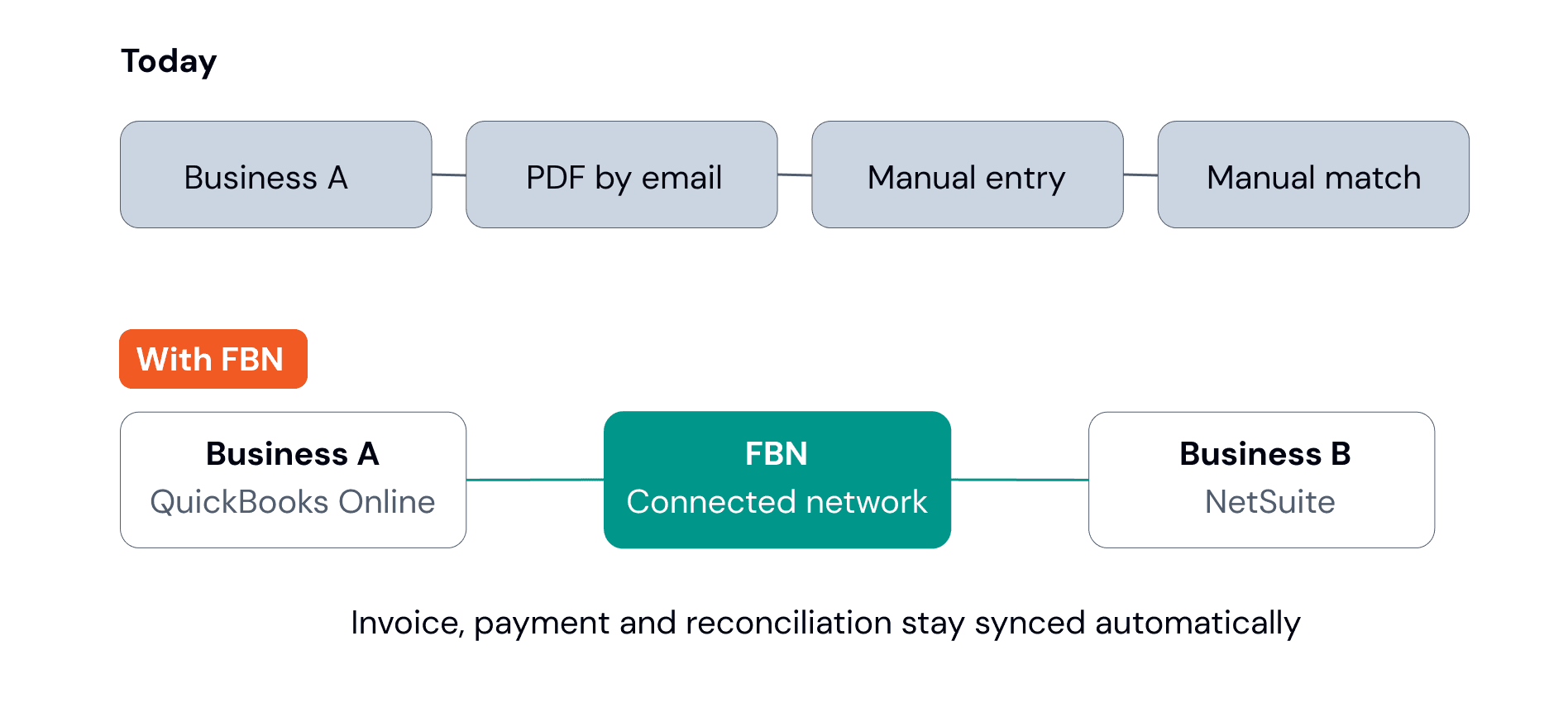
FBN replaces that document exchange with direct system-to-system connectivity. Once two businesses are connected on the network, a few things change:
Invoices sync as data, not documents: An invoice created in one business's accounting system is transmitted as structured data directly into the other business's system, no PDF, no manual entry on either side.
Payment status updates in real time: When a payment is scheduled, sent, or completed, both sides see the update immediately, removing the need for confirmation emails or status check-ins.
Payment credentials are stored once: Banking details are saved securely and reused across the network, so businesses aren't re-sharing account information with every new counterparty.
Remittance data flows automatically: Rich remittance detail moves directly into accounting systems on both sides, saving AR teams the hours normally spent matching payments to invoices by hand.
The network effect is what makes this compound over time. A single connection between two businesses solves a point-to-point problem. But as each business invites its own vendors, clients, and accountants onto the network, the number of synchronized relationships grows faster than the number of businesses joining. A supplier connected to ten customers who each connect to twenty vendors of their own quickly ends up with far more synchronized relationships than the headcount suggests, and document-based workflows become the exception rather than the norm.
How FBN differs from a typical accounting integration
Most "integrations" between accounting platforms aren't really connections between businesses at all. They're a connection between one business's software and a middleman, usually a bank feed or a generic API that pulls transaction data after the fact. That works for reconciling what already happened, but it doesn't help two businesses coordinate a payment before it happens, and it definitely doesn't let a vendor's invoice show up automatically in a customer's AP system the moment it's created.
FBN is built differently because it connects the businesses themselves, not just each business to its own software. Once a vendor and a customer are both on the network, the relationship between them becomes the thing that's synced, not just each side's internal records. That's a structural difference, not just a feature difference, and it's why the value compounds as more businesses join rather than staying flat the way a typical point-to-point integration does.
Why this matters for finance teams
Faster payments
Because both sides are connected directly, payments move without the delays caused by manual approval routing, mailed checks, or waiting on a vendor to confirm receipt. A payment scheduled on one side shows up as expected on the other almost immediately, instead of both teams working off assumptions about timing.
Free payments between connected businesses
Two businesses transacting on FBN don't pay processing fees to move money between each other, a meaningfully different economics than platforms that charge a fee on every transaction regardless of who's on the other end. For a business with a handful of regular counterparties, that adds up quickly over a year.
Less manual reconciliation
Since invoice and payment data sync automatically through the platform's 2-way sync with accounting systems, AP and AR teams spend less time matching transactions and more time on actual review and exceptions. The busywork of chasing down which invoice a payment belongs to mostly disappears.Fewer errors from re-entry.
Fewer errors from re-entry
Every time data gets typed in by hand, there's a chance of a mistake, whether that's a transposed number or a missed line item. Removing that step removes the errors that come with it, along with the time spent tracking those errors down after the fact.
Cleaner audit trails
Because status and remittance data update automatically on both sides, there's a real-time record of what happened and when, rather than a trail of emails to piece together after the fact. That matters as much for internal review as it does for an actual audit.
Getting started on the network
Joining FBN doesn't require a business to onboard every vendor and customer at once. Most businesses start by connecting with the counterparties they transact with most frequently, then expand as more of their vendors and clients join. Because the network compounds in value as more businesses connect, even a handful of active connections tends to eliminate a meaningful share of the manual work a finance team was doing before.
Don't just move money. Move the data with it. If your finance team is still reconciling by hand, see how the Forwardly Business Network works or start a free trial to see how it changes your own workflow.
By:
Maninder Sidhu
Published

